
Why Multi-Region Failure Verification Stops False Downtime Alerts
Learn how multi-region monitoring strengthens uptime monitoring, cuts false positives and improves incident alerting—while revealing limits reliability.
How Multi-Region Monitoring Reduces False Downtime Alerts (And Where It Still Falls Short)
 Alt text: World map illustration showing multiple monitoring probes in different cities checking a single server before confirming an alert.
In short: a single monitoring probe can't tell the difference between your server being down and a network hiccup on its own path to you. Multi-region monitoring checks from several independent locations before firing an alert, which meaningfully reduces false positives caused by one flaky route. It doesn't eliminate them — confirmation typically adds 15–60 seconds before a real outage pages you, and failures across shared infrastructure can still slip through looking like independent agreement. Used well, though, it's usually the difference between trusting your alerts and muting them.
If you've ever stared at a 3am alert, checked your site from your phone, watched it load perfectly fine, and gone back to bed fuming, you know exactly what I'm talking about. Let's look at why this happens, how multi-region monitoring actually works, and where it still falls short.
Why Single-Region Uptime Monitoring Creates False Alerts
Imagine hiring one person to watch your storefront from across the street with a slightly foggy pair of binoculars. Most days they see clearly. But every so often a bus drives past and they genuinely can't tell if your shop is open or closed. A single-location monitoring check has the same blind spot — except instead of fog, it's dealing with ISP routing quirks, congested network hops, and DNS resolution delays.
A monitoring node reaches your server over one specific network path, through specific ISPs and specific regional infrastructure. A dropped packet, a congested hop, or an unresponsive resolver produces a failed check that looks identical to your server actually being unreachable. From a single vantage point, there's no reliable way to tell "your site is down" from "the road between me and your site has a pothole."
A failed check can mean one of three quite different things:
| What actually happened | Who's affected | Real incident? |
|---|---|---|
| Global downtime — service unreachable from everywhere | All users | Yes |
| Regional downtime — a CDN edge or regional cloud issue affects one area | Users in that region only | Yes, but narrower |
| Probe-path failure — the monitoring node's route has a problem | No real users | No |
Single-region monitoring can only report "failed" or "succeeded" — it has no way to sort a failure into one of those three buckets. That ambiguity is expensive: engineers who get paged for phantom outages start shrugging off alerts, or lose sleep over nothing. Either way, the core job of monitoring — giving you something to act on without second-guessing — quietly erodes.
It's also worth being clear about what a successful check actually proves. A response from three regions tells you your server answered a request over three network paths. It doesn't tell you that login works, that a specific ISP's users can reach you, or that a broken feature deeper in your app is fine. Multi-region monitoring verifies reachability, not the full user experience — which matters, but is a narrower claim than "everything's working."
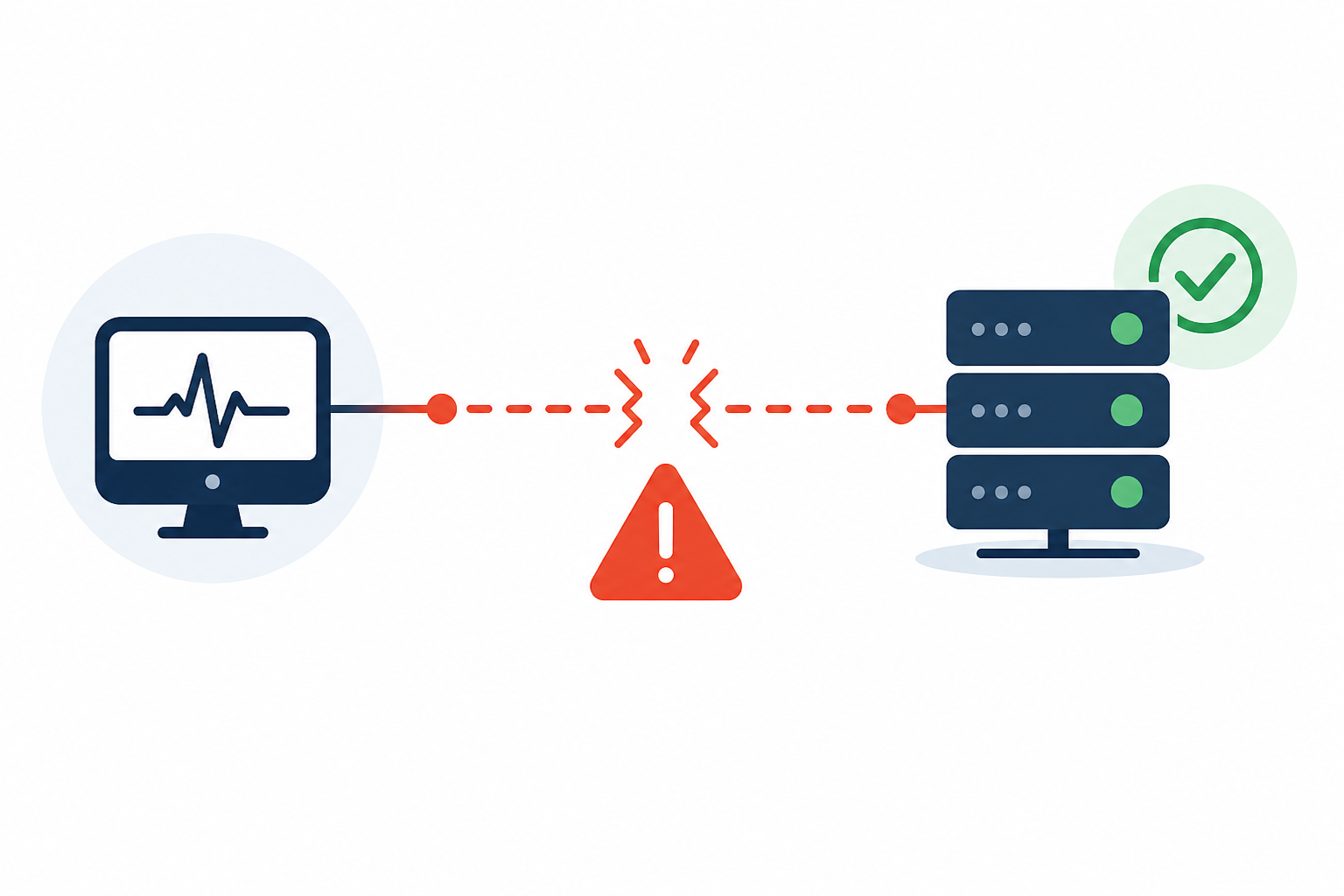 Alt text: A single monitoring probe with a broken line to a server, illustrating how a local network issue can be mistaken for downtime.
How Multi-Region Failure Verification Works
Instead of trusting one observer, multi-region monitoring asks several independent observers, in different cities, to look before anyone sounds the alarm. The exact numbers below are policy choices, not industry standards — you'd tune them to your own risk tolerance.
Multi-region detection and confirmation
- A primary probe detects a failure. Say an HTTP/S monitor checking from London gets a timeout.
- The system retries before escalating. One or two retries over 20–30 seconds filters out a single slow response — plenty of "failures" are exactly that.
- If retries still fail, secondary regions check independently. Probes in, say, Frankfurt, Dublin, and Singapore each run their own check within a short confirmation window (commonly 10–20 seconds).
- A quorum rule decides what counts as confirmed. Requiring three of five regions to agree is faster but accepts a small false-negative risk; requiring unanimous agreement is more conservative but slower to confirm real outages. Neither is objectively correct — it's a trade-off you set deliberately.
Distinguishing regional and global incidents
- The system checks whether the failure matches your actual audience. If you're UK-facing and the regions failing are the ones closest to UK users, that's worth paging on even if far-flung regions succeed — a regional failure that hits your real customers is a real incident, not noise.
| Failing regions | Matches your users? | Likely classification |
|---|---|---|
| All regions | N/A | Global incident — page immediately |
| Only regions near your users | Yes | Regional incident — page it |
| Only distant, unrelated regions | No | Low priority — log and watch |
Alert routing after verification
- Only then does incident alerting fire — email, Slack, Discord, Telegram, or a webhook.
A concrete example: a London outage that wasn't
Here's what that sequence looks like in practice. At 03:00:00, a primary probe in London times out on an HTTPS check. Two retries, at 03:00:05 and 03:00:20, both time out too, so the failure escalates. At 03:00:25, Dublin and Frankfurt run independent checks — both succeed. At 03:00:28, a second London-adjacent probe also fails. With a quorum rule of "two of three secondary regions must agree," only one of three secondary checks failed, so the incident isn't confirmed. It gets logged as a probe-path issue on that specific London route rather than paged — and if it recurs from the same route within the next hour, that pattern gets flagged for a closer look, because a single blip is noise but a repeating one is a signal worth investigating.
Compare that to a genuine regional incident: the same primary failure, but this time Dublin and the second London probe also fail while only Singapore succeeds. That's two of three secondary regions agreeing, quorum is met, and because the failing regions are exactly where your UK users sit, it pages as a confirmed regional incident rather than a global one.
One caveat worth keeping in mind through all of this: agreement across regions increases confidence, but it doesn't prove independence. Probes only count as genuinely independent if they run on different networks, different upstream providers, and ideally different DNS resolvers. If several regions share a dependency — the same CDN, the same resolver, the same cloud provider's networking layer — a fault there can make "independent" probes fail together even though nothing's wrong with your origin server.
How check type affects multi-region confirmation
| Check type | What a single failure might mean | How much does multi-region confirmation help? |
|---|---|---|
| HTTP/S | Timeout or 5xx — genuinely ambiguous on its own | Most helpful — directly confirms server vs. path |
| ICMP (ping) | Often just blocked ICMP, not a downed host | Limited — many networks block ping entirely, so a TCP or HTTP check is usually more trustworthy |
| TLS/SSL | A real certificate problem, or a regional TLS negotiation quirk | Helpful — worth confirming before assuming your cert is broken |
| DNS | Resolver cache differences, a delegation error, or an unreachable authoritative server are different problems | Only really helps confirm the last of those — the other two need direct investigation, not just another region |
| Heartbeat/cron | A late signal could be jitter, or the job may have genuinely failed | Doesn't apply the same way — a repeating pattern of late heartbeats needs investigating regardless of network conditions |
Real-World Causes of False Downtime Alerts
Probe-path issues that are not real incidents
- ISP-level routing issues between the monitoring node and your server — a path problem, not an infrastructure problem, though worth tracking if it recurs from the same region.
- Network exchange congestion between the probe and your server, usually transient and resolved on retry.
- Blocked ICMP, which produces a failed ping even though the host is perfectly reachable over TCP or HTTP.
- Transient TLS handshake hiccups during a single check, which usually resolve on retry.
Regional failures that are still real incidents
- CDN edge or firewall rules that reject requests from specific geographic IP ranges. If a whole region genuinely can't reach your edge node, that's a real, if localised, availability problem for the people living there.
- DNS resolution failures specific to one region — for example, an authoritative server unreachable from certain networks, or a delegation error affecting one resolver population. If this persists beyond a few minutes rather than clearing on its own, it usually points to a genuine configuration issue rather than transient noise.
- Repeated TLS failures from the same region only, which can indicate a certificate or cipher mismatch that only surfaces under specific network conditions.
- A consistent pattern of late or missing heartbeats, which is rarely a network artefact and usually means the underlying job needs attention.
The honest takeaway: multi-region verification filters out a good chunk of single-path noise, but it works best alongside sensible retries, realistic timeouts, and a habit of checking which regions disagree and why.
Reducing Alert Fatigue for On-Call Engineers
Alert fatigue is usually described as a volume problem, but it's really a trust-and-volume problem. Fifty pages a day is exhausting on its own, but it's low signal quality — pages that turn out to be nothing — that does the lasting damage. The moment an on-call engineer gets burned by a false page, the next one gets treated with a little more suspicion, and the one after that with even more.
That's worth measuring, not just describing. A few metrics worth tracking over a rolling month, along with what to do when they move in the wrong direction:
- Alert precision — the percentage of pages that corresponded to a real, actionable incident. If this is falling, tighten your quorum rule or add a retry before you touch anything else.
- Confirmation rate — how often a primary failure was upheld after multi-region verification versus dismissed as a probe-path issue. A consistently low confirmation rate from one region suggests that specific probe's route is unreliable and worth investigating or replacing.
- Mean time to acknowledge (MTTA) — if this is creeping up, your team may be hesitating before checking pages, which is the alert-fatigue spiral in action. Treat it as a trust problem to fix, not a discipline problem.
- Alerts per service per week — a rising trend without a matching rise in real incidents usually means your thresholds need retuning, not that your infrastructure got worse.
Multi-region verification helps these numbers, but it's one piece of a broader fix. Pair it with severity tiers (a confirmed global outage should page differently than a single-region degradation), deduplication so one issue doesn't generate five pages, escalation delays that give a first responder a short window to acknowledge, and regional tagging so on-call engineers immediately know whether a confirmed failure affects everyone or just one part of the world.
Choosing an Uptime Monitor With Proper Failure Confirmation
If you're evaluating monitoring tools, work through this before committing — especially for a UK-facing service where regional accuracy matters:
- How many verification regions does it use, and can you pick them? Three or more independent regions is a stronger signal than two — but for a UK audience, probes near London, Dublin, and continental Europe matter more than probes scattered globally with none near your actual users.
- Are the regions actually independent? Ask whether verification probes run on different networks, different upstream providers, and different DNS resolvers — not just different data centres owned by the same backbone. Geographic distance alone doesn't guarantee independence; two data centres on opposite sides of a continent can still share the same upstream transit provider.
- Can you configure confirmation thresholds? Look for control over quorum (majority vs. unanimous), retry count, and the time window between initial failure and secondary checks.
- Does it distinguish global from regional incidents? A tool that can say "confirmed only in the UK/EU region" is more useful than a flat "confirmed"/"not confirmed."
- Can you see the raw per-region results and timestamps for a past incident — not just a final verdict — so you can tell a consistently flaky route from a genuine, localised outage?
- Does it offer a public status page you can share with customers or stakeholders, showing verified regional results rather than a single up/down toggle?
- What's the cost of stricter verification? Tighter quorum rules reduce false positives but add seconds — sometimes tens of seconds — to detection time, and can occasionally delay a real alert. Know that trade-off going in.
- Does it support the alerting channels your team uses, with sensible severity and deduplication settings, and can you export your monitoring data freely?
If most of your users are in the UK, it's worth remembering that "multi-region" doesn't automatically mean useful regions. A service behind a CDN might route all its "UK" traffic through London regardless of where the user physically sits, so probes in Dublin, Frankfurt, or Amsterdam often give you more genuine path diversity than five data centres scattered across the US that no UK user's traffic would ever touch.
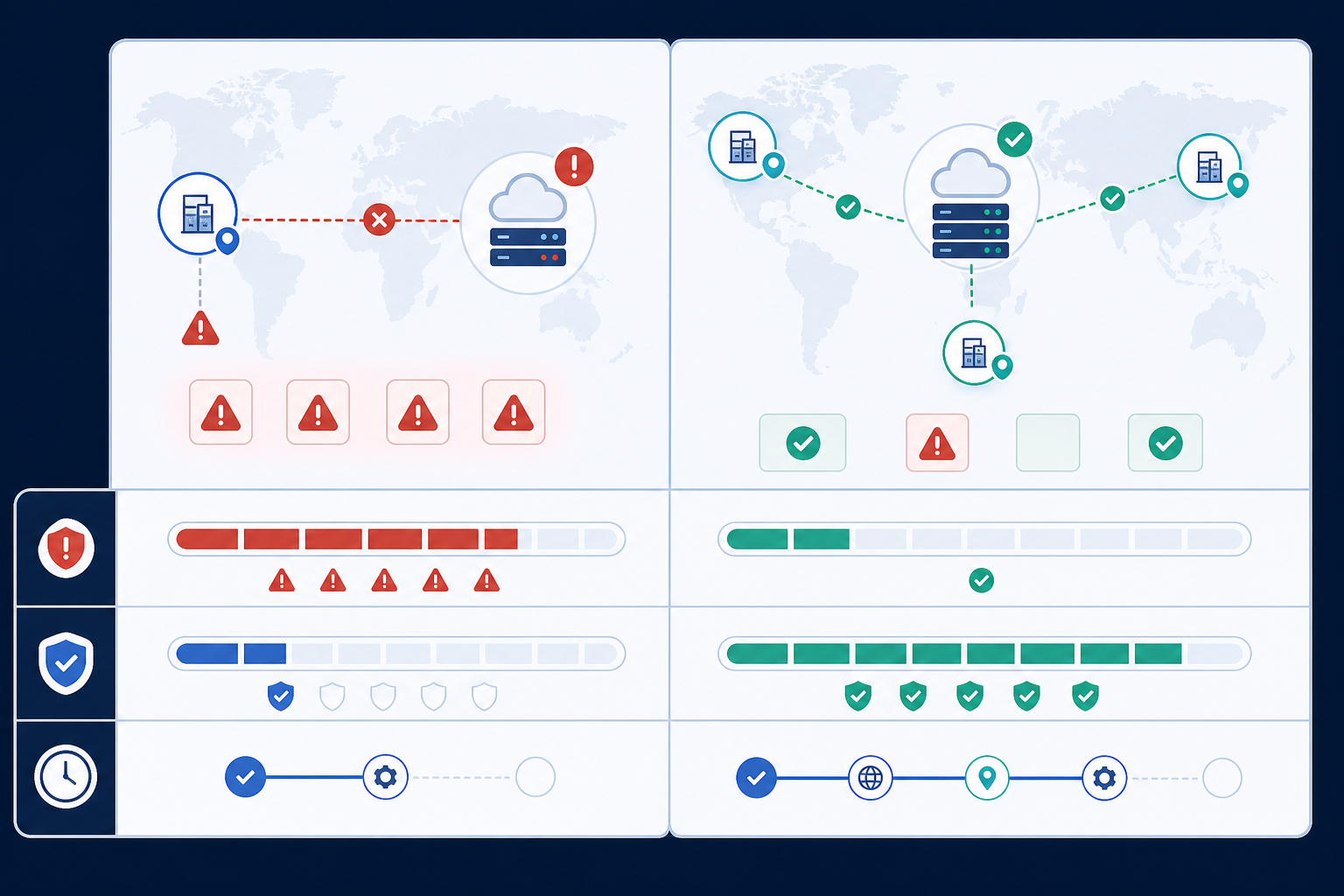 Alt text: Table comparing single-region and multi-region monitoring across false positive tendency, detection speed, setup complexity, and diagnostic value.
| Single-Region Monitoring | Multi-Region Monitoring | |
|---|---|---|
| False positive tendency | Higher — a local network blip can trigger an alert alone | Lower for independent-path issues, though correlated failures across shared infrastructure can still slip through |
| Detection speed | Fastest — no confirmation delay | Slightly slower — typically 15–60 seconds added for confirmation, depending on settings |
| Setup complexity | Minimal | A bit more up front (regions, thresholds, quorum), often templated by the platform |
| Diagnostic value | Limited — one data point | Higher — shows which regions agreed or disagreed |
A worked example of regional incident alerting
For a UK-facing API: primary probe fails, two retries over 20 seconds, then three additional regions (Dublin, Frankfurt, a second London-adjacent probe) check independently within a 15-second window. Two of three agreeing confirms the incident — paged as "regional" if it matches your UK/EU user base, or "global" if distant regions are failing too. For a globally distributed API where every region matters equally, you might instead require a majority of five or more geographically spread regions before paging at all. Neither policy is universally right; it depends on how conservative you want to be and where your users actually are.
Where Moonitor fits
We built multi-region failure verification into Moonitor's website, API, and server monitors as a standard part of how every check runs — not an add-on you have to configure from scratch. You pick your verification regions, including probes across the UK and continental Europe, set retry counts and quorum rules, and get a public status page you can share with customers, all with sensible defaults out of the box. Most people have their first monitor running, with multi-region confirmation already active, in under a minute — you can tighten the thresholds later once you've seen how your specific service actually behaves.
If you're comparing tools, run this against the checklist above rather than taking our word for it. What matters is that whichever platform you choose gives you real control over regions, thresholds, and regional-versus-global severity — and is honest with you about the trade-off between speed and certainty.
Frequently Asked Questions About Multi-Region Monitoring
Why do I get downtime alerts when my site is actually up?
Usually it's a single-region monitoring problem: a temporary network issue between the probe and your server — not your site being down — triggers a failed check. Check whether your monitor retries and confirms from other regions before alerting; if it doesn't, that's the first thing to fix, regardless of which tool you're using.
What is multi-region failure verification?
A suspected outage detected by one probe is retried, then re-checked from other geographically distributed regions within a defined window. If enough regions independently agree — based on a quorum rule such as majority or unanimous agreement — the system treats it as confirmed and alerts, ideally tagging whether the confirmed failure is regional or global.
How can I reduce false positives in uptime monitoring?
Use a platform with configurable retries, sensible timeouts, and multi-region verification with adjustable quorum — not a single check point with no retry logic. Just as important: make sure it shows which regions flagged the issue and lets you inspect raw results, so you can tell a consistently flaky route from a genuine, localised outage.
What about failures that show up in multiple regions but aren't real outages?
This happens when regions share a dependency — the same DNS resolver, CDN, or upstream network. If several regions fail in a similar pattern, check whether they share infrastructure before assuming it's your origin server; multi-region agreement is strong evidence, not absolute proof.
Does multi-region verification slow down how quickly I find out about real outages?
Yes, a little — typically 15 to 60 seconds, depending on retry and quorum settings. For most teams that's worth it, since it cuts the much larger cost of false alarms. If speed matters more than certainty for a specific service, loosen the quorum or reduce retries — just know you're trading some false-positive protection for faster detection.
Getting Multi-Region Monitoring Right
The point of all this isn't chasing a feature checklist. It's building a monitoring setup you genuinely believe when it speaks up — where an alert means something is actually wrong for someone, not "maybe check, maybe don't."
Start simple: pick two or three regions that actually reflect where your users are, set a quorum you can explain in one sentence — "two of three agree" is a fine starting point — and give it a few weeks of real data before touching it again. Then look at your alert precision number. If it's climbing toward 90%+, you've built something your team can trust. If it's not, adjust one variable at a time — retries, quorum, or which regions you're checking from — rather than all three at once. That trust is worth more than almost any other feature you could add.