
Why Multi-Region Verification Stops False Downtime Alerts
Learn how downtime verification confirms failures across regions, filters false positives, and reduces noisy alerts and on-call fatigue.
Downtime Verification: How It Stops False Downtime Alerts
If you've ever been jolted awake at 3am by a downtime alert, only to find your site loading perfectly fine on your phone, you already know the frustration. I've been there too, squinting at my screen at an ungodly hour, refreshing a page that clearly isn't broken. Here's the short version: downtime verification is the process of confirming a suspected failure from multiple independent monitoring locations before an alert reaches you. Without it, a single flaky network path can look exactly like a genuine outage.
False downtime alerts commonly come from a single monitoring location hitting a temporary network hiccup, an ISP routing issue, or a regional outage that has nothing to do with your actual service. But that's not the only cause. Bad timeout settings, application-level errors, authentication problems, or an overly aggressive alert threshold can trigger false positives too, and multi-region checking won't fix those on its own.
For the specific problem of "my monitor says I'm down and my users say I'm fine," multi-region verification is the fix. It requires a failure to be confirmed from two or more independent locations before triggering an alert.
This is how downtime verification works inside Moonitor by default, and it's one of the biggest reasons teams switch to us after getting burned by noisy monitoring elsewhere.
Let's look at why single-region checks misfire, how multi-region verification actually works, and how it cuts down on false positives and on-call fatigue.
The problem with single-region checks
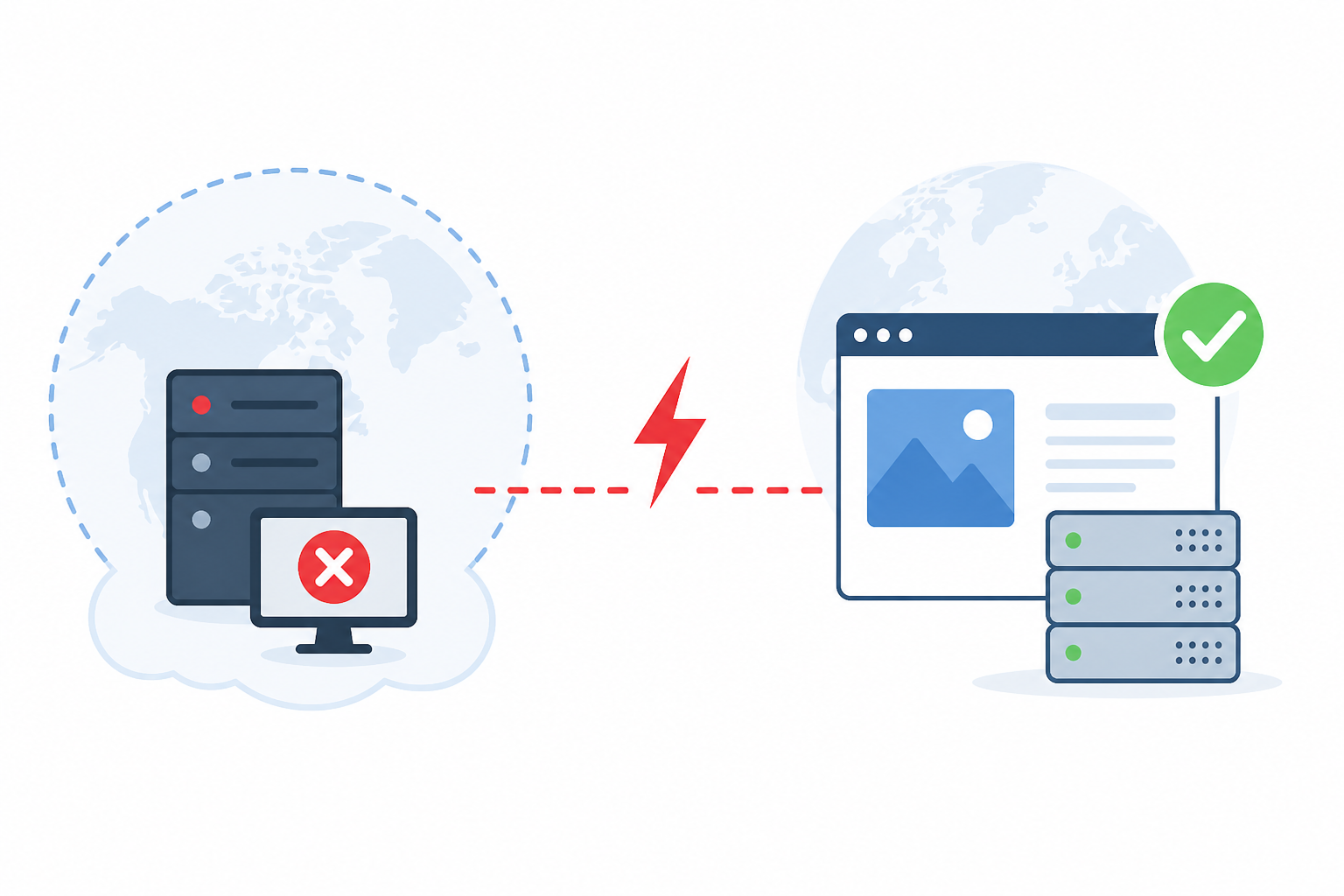
Here's what happens when a basic monitor checks your site from one data centre: it uses a single network path, a single DNS resolver, and a single ISP's infrastructure to reach you. If anything stumbles along that path, the check fails, even if your service itself is completely healthy.
That's the core distinction worth remembering: a monitor failure (something that went wrong between the checking location and your server) is not the same as a service failure, where something is actually broken on your end. A single-region check can't tell these apart. It has exactly one vantage point, so any problem along that route gets reported as downtime.
A flaky peering route between two providers, a brief CDN issue, or a DNS resolver having a rough moment can all look identical to real downtime when you're checking from only one place. The monitor can't distinguish between "the internet had a rough few seconds between Frankfurt and my server" and "my server is actually down."
Here's a concrete example. Say a monitor in Frankfurt tries to reach your site and times out because of a temporary routing issue between two network providers. Meanwhile, your site is completely reachable from London, Dublin and Virginia. Nothing is wrong with your infrastructure. But if Frankfurt is your only monitoring location, you're about to get paged for an outage that never really existed.
For a UK-based team, this matters in a practical way. If your customers are mainly in the UK and Europe, a check running only from a US data centre might occasionally flag a transatlantic routing hiccup as downtime, even though your actual users can reach the site without issue. The fix isn't simply "more regions." It's choosing regions that reflect where your traffic and risk actually sit.
And to be clear, this isn't a monitoring tool being bad at its job. It's a structural limitation of checking from a single location. The internet is a sprawling mess of interconnected networks, and any individual point within it will occasionally hit a snag that has nothing to do with your website.
How multi-region downtime verification works
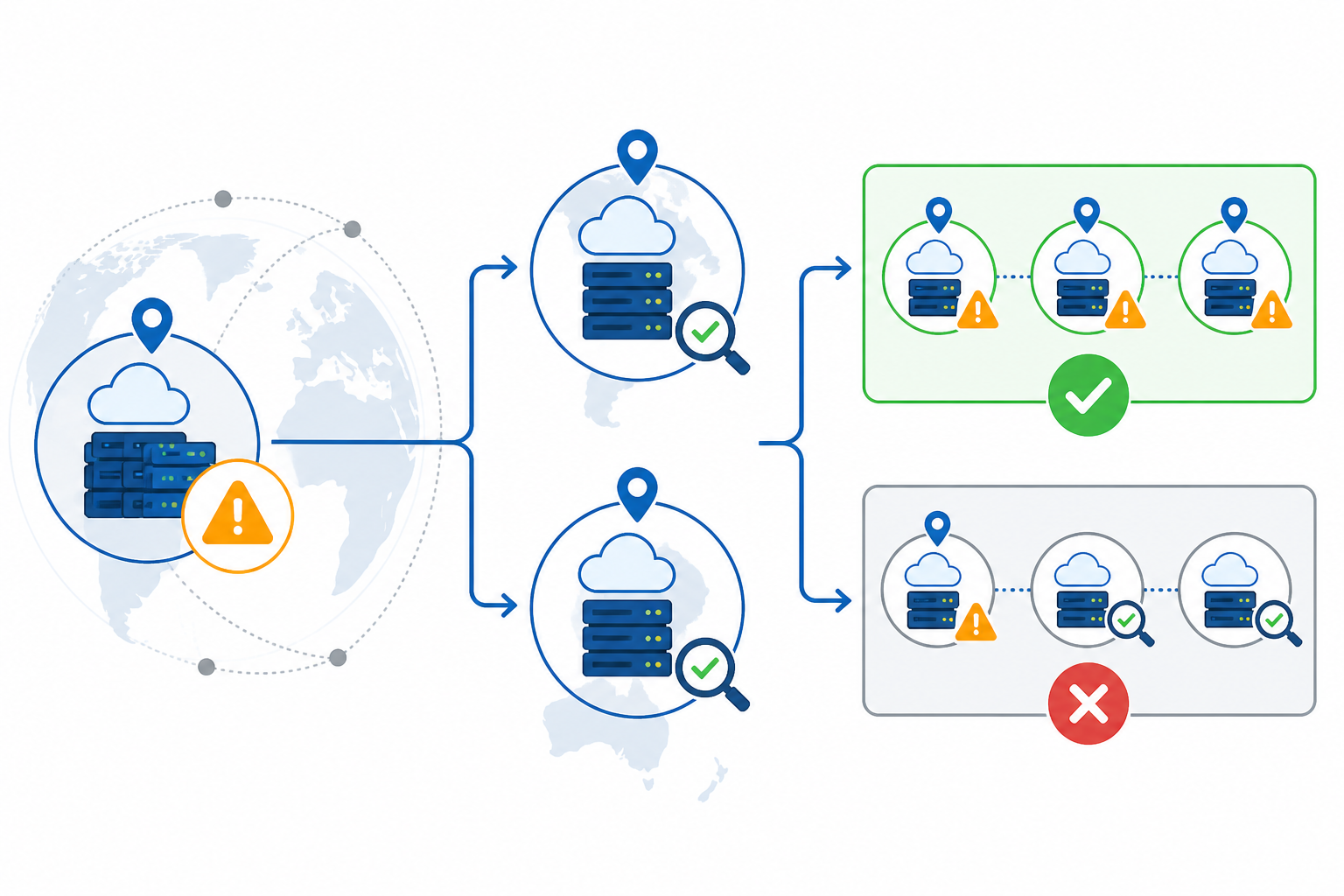
Once you understand the problem, the fix is pretty intuitive: don't trust one opinion when you can ask several independent monitoring locations. Here's roughly how the verification workflow runs.
- A primary monitor detects a failure. This could be a timeout, an unexpected status code, an SSL handshake error, or another signal that something's wrong.
- The system kicks off verification checks from additional, geographically distinct regions. Instead of firing off an alert the moment one check fails, it pauses briefly while other locations weigh in with a second and third opinion.
- The monitoring system compares the results. If enough regions (based on your configured threshold) confirm the failure, it's marked as a genuine incident.
- A failure reported by only one region gets treated as a regional anomaly. It's still logged for transparency, but no downtime alert goes out.
Example: a 2-of-3 verification threshold
Imagine a monitor checking your service from London, Frankfurt and Virginia. If only Frankfurt reports a failure, it's logged as a regional anomaly and nothing gets sent. If Frankfurt and Virginia both flag it, the 2-of-3 threshold is met and it escalates to a confirmed incident. If all three regions report a failure, there's not much ambiguity left. Your service is probably genuinely down.
There's a trade-off here worth naming. A 2-of-3 policy is good at filtering out one-off, location-specific network noise. But it can occasionally mask a genuinely regional problem. For example, a hosting provider might have an issue affecting traffic from Europe while two of your three monitoring regions sit outside Europe entirely.
That's why picking verification regions that reflect your actual user base matters more than just grabbing three random locations off a list. A UK-focused website may do better with checks in London or Dublin alongside other European and North American spots.
The verification step usually adds only a few seconds before an alert goes out. That's a small price to pay compared with getting paged for something that isn't actually affecting your service.
Real examples of false positives in uptime monitoring
Specific examples make this pattern much easier to spot. Here are common situations where a single-region check can misfire, along with some nuance about what multi-region monitoring can and can't actually confirm.
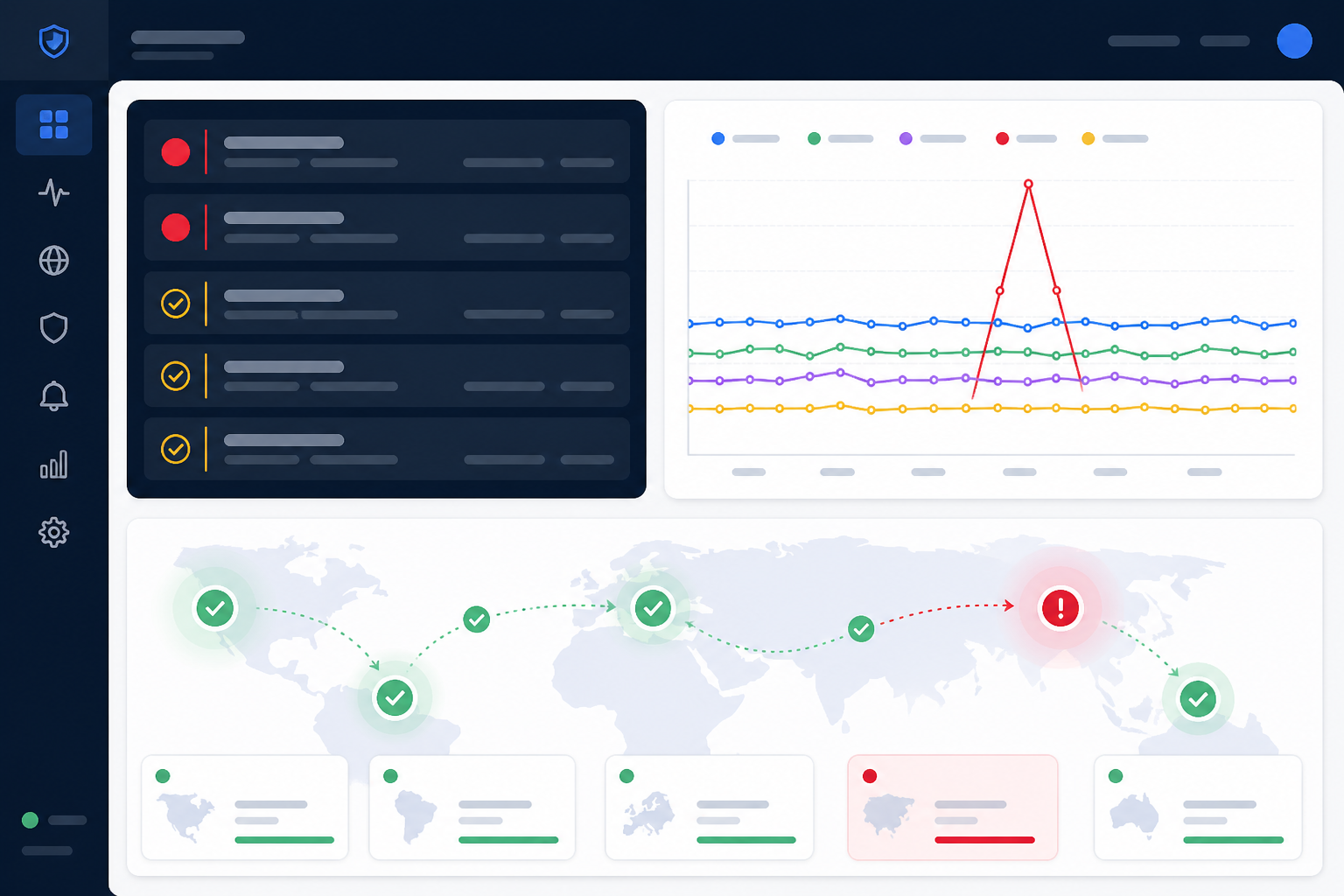
- Cron job monitoring: A heartbeat monitor flags a missed check-in, but the monitoring node's own network connection briefly dropped while your scheduled job ran just fine. Verification mainly confirms the monitor's reachability here, not the job itself.
- SSL certificate monitoring: A check reports an SSL error because of a regional TLS handshake timeout, not because your certificate is expired or misconfigured. Cross-region checks help, though a genuine certificate problem usually shows up everywhere anyway.
- DNS monitoring: An alert fires because one resolver returns a stale cached record while other resolvers have the correct, updated value. Sometimes that's a false positive, but it can also reflect normal DNS propagation, so disagreement between resolvers is worth investigating rather than dismissing automatically.
- Port and ping monitoring: A server appears unreachable during a brief BGP route flap that resolves in under 10 seconds, long before anyone could open a laptop and start investigating.
The thread connecting all of these: from a single location, each one can look exactly like a real outage. Multi-region downtime verification is good at filtering out location-specific noise, but it works best when you understand what each monitor type is actually checking in the first place.
How downtime verification reduces on-call fatigue
False positives cost more than just annoyance. Someone gets paged at 3am, checks the dashboard, and finds nothing wrong. The site's up, the API is responding, the server is healthy. They go back to bed irritated, and a little less trusting of the system that just interrupted their sleep for nothing.
This is alert fatigue, and it's a well-documented problem in reliability and security work. When alerts cry wolf too often, people start tuning them out, including the legitimate ones. It's a bit like a car alarm going off repeatedly in a car park. After the third time, nobody looks up anymore.
That creates a real operational risk. When an actual incident hits, your team may respond more slowly because they've been trained, unintentionally, to assume alerts are just noise.
A few useful things to track if you want to know whether false positives are hurting your team:
- False-positive rate: the percentage of alerts that turn out to be non-issues.
- Mean time to acknowledge: whether response times are creeping up as trust in alerts declines.
- Regional anomaly rate: how many incidents get dismissed as regional anomalies versus confirmed as genuine outages.
If a third or more of your alerts turn out to be non-issues, it's worth taking a closer look at your verification setup. The goal isn't more notifications. It's the right ones, the ones that actually need a human.
This problem gets worse for teams using shared channels. If alerts land in Slack, Discord, Telegram or a webhook, a false positive doesn't just annoy one on-call engineer. It spams a whole channel your team relies on. Over time, people mute it, and you've lost the entire point of having it.
How Moonitor verifies downtime alerts
We built Moonitor specifically to cut down on this kind of monitoring noise. By default, checks run across multiple independent regions. When a failure is detected, Moonitor automatically re-verifies it from additional locations before triggering an alert, and you don't need to set up anything extra for this baseline protection to kick in.
This verification logic applies across our supported monitor types, including:
- HTTP and HTTPS monitoring
- Keyword monitoring
- Port and ping checks
- SSL and domain expiration monitoring
- Cron and heartbeat monitoring
The exact verification behaviour varies a bit by monitor type, since each one is checking a different condition. Default regions and thresholds may also differ depending on your plan and monitor configuration, so check your dashboard settings for the specifics on your account.
Verification results feed into your incident history, so you get a record of which events were confirmed as genuine downtime and which got dismissed as regional anomalies. When you're reviewing uptime trends for a status page, or explaining an incident to a client, that cleaner signal makes a real difference.
Setting up downtime verification rules
It helps to separate what happens automatically from what you can tune yourself.
What happens by default: Moonitor runs checks from multiple regions and applies verification before escalating a failure into an alert. You don't need to configure anything for this baseline protection to be active.
What you can configure, depending on your plan and monitor type:
- Choose your monitor type in the dashboard: website monitoring, API monitoring, server monitoring, or another supported type.
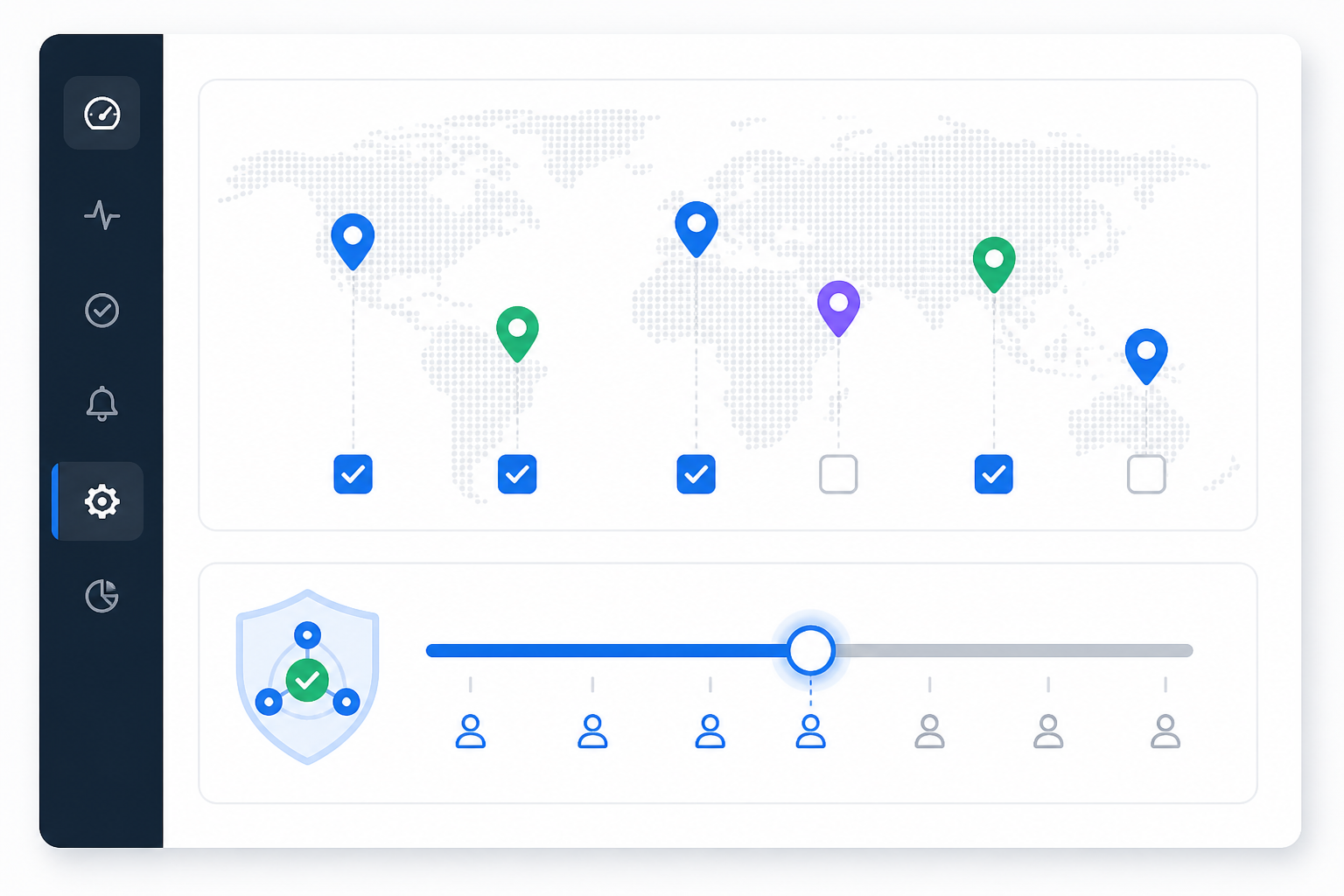
- Select your verification regions, where available. Pick locations close to your actual user base. For a UK-focused service, that might mean London or Dublin alongside another European and a US location.
- Set your verification threshold, such as requiring two out of three regions to agree before confirming an incident. This is what determines how cautious or sensitive your alerting is.
- Connect your alert channels, including email, Slack, Discord, Telegram or webhooks, so only confirmed incidents actually reach your team.
- Review your incident history regularly and adjust thresholds based on how your infrastructure behaves. Revisit these settings if your user base, hosting provider, or traffic patterns change.
Frequently asked questions about downtime verification
Why do I get downtime alerts when my site is actually up?
This usually happens because your check ran from a single location that hit a temporary network issue, routing problem, DNS hiccup, or brief ISP outage. From that one vantage point, your site looked unavailable even though users elsewhere could reach it fine.
How does multi-region checking reduce monitoring noise?
Instead of trusting one failed check, downtime verification re-tests the service from independent locations before confirming an incident. If only one region reports a problem, it's treated as a regional anomaly rather than genuine downtime. You get alerted once the failure is confirmed across multiple locations, not before.
What causes false positives in uptime monitoring?
Common culprits include regional routing issues, DNS resolver inconsistencies, brief CDN or ISP outages, and transient TLS handshake failures. Misconfigured timeouts, application bugs, and overly strict alert thresholds can also cause false positives, though multi-region verification mainly helps with the location-specific ones.
How do I choose regions for downtime verification?
Pick regions that reflect where your users actually are. A UK-focused service might use London or Dublin as a primary region, paired with one or two locations in Europe or North America. That way, confirmed incidents actually reflect what your audience is experiencing.
Does downtime verification delay real outage alerts?
Only slightly. Verification typically adds a few seconds while additional regions confirm the failure. That's a small trade-off next to the time lost chasing false positives and the longer-term toll of alert fatigue.
The takeaway
Good monitoring isn't about catching every possible blip. It's about catching the failures that actually matter, and knowing the difference is what saves you from needless 3am scrambles. Downtime verification is a quiet feature, but it does a lot of heavy lifting for keeping your team's trust in its own alerts intact.
If you're currently getting paged for outages that turn out to be nothing, check your false-positive rate and take a look at which regions your monitors actually use. Choosing sensible monitoring locations and requiring confirmation from multiple independent regions makes your alerting more reliable, cuts the noise, and gives your on-call team a much clearer picture of what's actually down.