
Why Multi-Region Failure Verification Prevents False Downtime Alerts
Learn how multi-region checks improve uptime monitoring accuracy, reduce false downtime alerts, and help on-call teams trust what their monitors repor
Uptime monitoring accuracy: how multi-region verification prevents false downtime alerts
It's 3am. Your phone buzzes. "Site down." Heart rate spikes, laptop opens, and... your API is responding just fine. Sound familiar? If you've ever been jolted awake by a monitoring alert that turned out to be nothing, you already know how frustrating unreliable uptime monitoring can be.
Here's the honest answer, straight up: a large share of false downtime alerts trace back to one root cause. A monitoring tool checks your site or API from a single location, and a network hiccup, ISP routing issue, or regional outage gets misread as your service being down. Multi-region verification fixes that specific problem by confirming an outage from two or more geographically separate checkpoints before firing an alert.
But it's worth saying clearly upfront: this isn't a cure-all. False positives can also come from probe timeouts, TLS negotiation failures, expired authentication tokens, badly written test assertions, or a monitor that's simply misconfigured. Multi-region checks solve the location-specific slice of the problem, not every possible cause of a bad alert.
Let's dig into why this happens, what good verification actually looks like under the hood, and where it still falls short.
What causes false downtime alerts?
I've talked to a lot of developers who assumed their monitoring tool was broken when, really, it was just doing exactly what it was designed to do: check from one place and trust that one place completely. The problem isn't the check itself. It's the lack of a second opinion.
Here's what typically goes wrong:
- Single-checkpoint monitoring means one bad network path looks identical to a real outage. If the monitor's server can't reach yours, it assumes yours is the problem, even when the issue is sitting somewhere in between.
- Regional ISP or backbone routing issues can block a monitoring location without affecting real users at all. A routing hiccup between, say, a data centre in Frankfurt and your server in London doesn't mean your actual visitors in Manchester or Dublin are having any trouble.
- Firewall or CDN edge-node hiccups that resolve in seconds can still trigger a check failure if the monitor happens to poll during that exact window. Your CDN's edge node in one region might briefly stumble while everything else runs smoothly.
- Temporary DNS resolution problems at the monitoring provider's location are a sneaky one. The monitor's own DNS resolver has a bad moment, fails to resolve your domain, and reports it as downtime, even though your DNS records are perfectly healthy.
- Monitor configuration and application-level issues, such as an overly strict response-time threshold, a keyword check looking for text that changed during a redesign, or an expired API token used for authentication, can all produce false failures that no amount of geographic redundancy will fix. This matters because multi-region verification only helps when the underlying test itself is sound.
- This matters even more for API monitoring and server monitoring than for static content, because APIs often depend on real-time backend calls, database connections, and third-party services, all of which introduce more points where a single checkpoint can misfire.
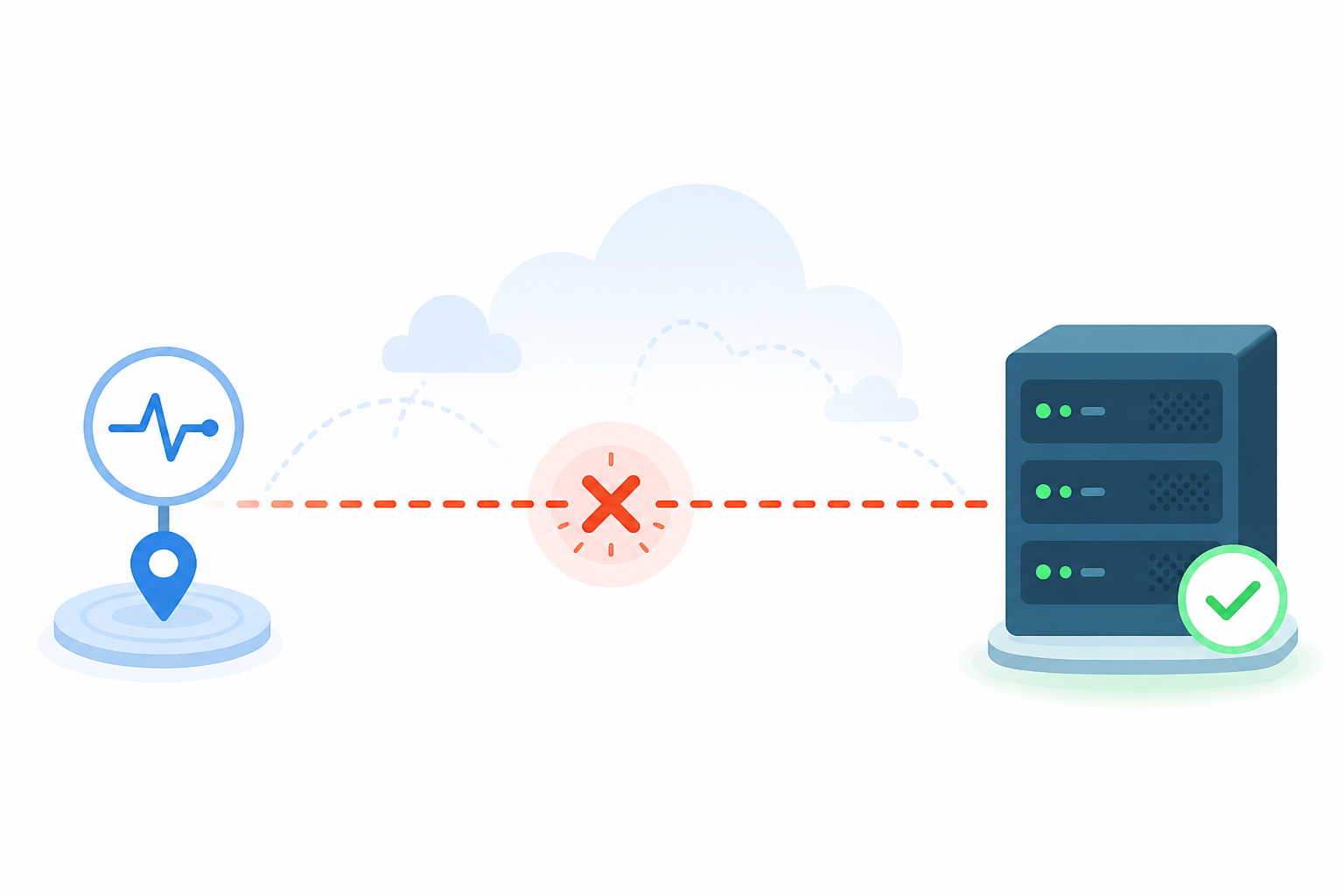
Think of it like calling a friend and getting a busy signal. Does that mean their phone is broken? Not necessarily. Maybe there's an issue with your line, not theirs. A single monitoring checkpoint is making a judgement call based on one phone call, and it's declaring your friend unreachable based on that alone. That's the core flaw in single-location checks, and it's why so many teams end up chasing ghosts instead of real problems. It's not the only flaw, but it's the most common one.
How does multi-region verification work?
So how do you fix this without slowing everything down or drowning your dashboard in delayed alerts? The trick is building a short, smart verification process into the monitoring logic itself. Here's how it typically plays out, step by step, along with the policy details that matter when you're configuring it.
- A monitor detects a failure from its primary checking region. Let's say your monitor usually checks from a data centre in London, and that check comes back failed: timeout, connection refused, or whatever the symptom.
- Before alerting, the system dispatches follow-up checks from other regions, typically with at least one retry per region to rule out a momentary blip. Instead of immediately alerting your Slack channel, the platform quietly pings your server again, this time from somewhere like Frankfurt and Singapore.
- A quorum policy decides what counts as confirmed. This is the part many tools gloss over. A common approach is that two out of three regions must report failure, with each failure confirmed after one retry within a 30-second window. Majority-vote policies work well for most services because they balance speed against confidence. All-region agreement, where every checkpoint has to fail before an alert fires, suits services such as payment APIs or checkout flows where a false alarm is far costlier than a few extra seconds of delay.
- If the quorum threshold is met, an incident is declared. This is the moment the system says, "okay, this isn't just one region having a bad day; this is genuinely down."
- If only one region reports failure, it's logged as a regional anomaly, not downtime. This distinction matters. Your incident history stays clean, and you're not left wondering later why there's a random outage logged that nobody actually experienced.
- Alerts go out only once the verification threshold is met, which keeps your incident history clean and your on-call rotation sane.
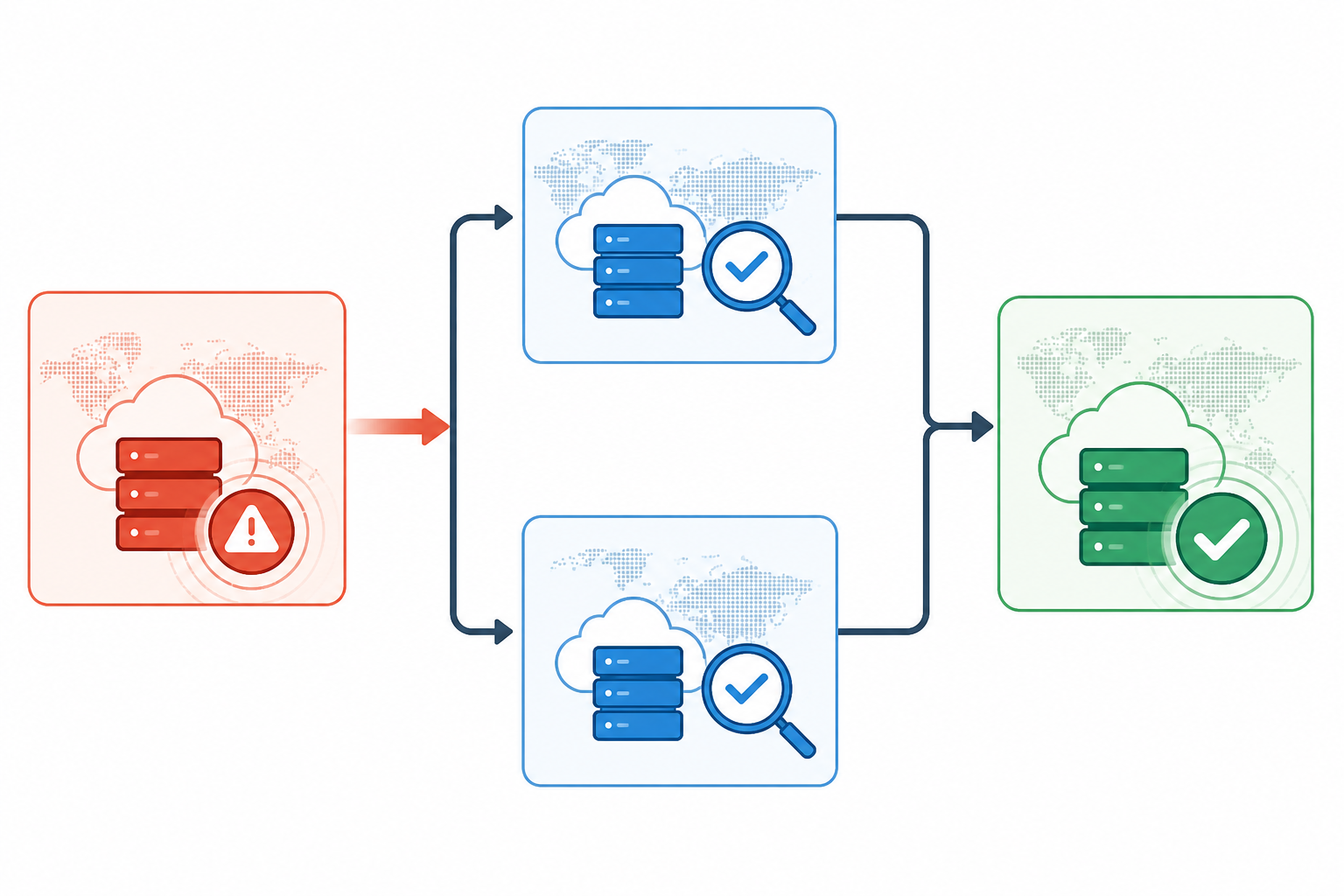
A quick honest caveat: multi-region verification tells you whether your service is reachable from several independent vantage points, not whether every single user everywhere can reach it. A distributed outage affecting a specific ISP, a CDN provider having a bad day across several regions at once, or a problem that's only visible to users in a particular country can still slip through if none of your checkpoints happen to sit in the affected path.
If most of your customers are in the UK, for example, a London-only checkpoint won't tell you much about someone trying to load your site from Edinburgh on a different ISP, or a visitor in continental Europe hitting a different CDN edge. Choosing checkpoint locations that reflect where your users are matters just as much as having multiple regions at all.
The good news is that this verification process usually only adds a few seconds of delay. That's a small price for not getting paged over nothing. At Moonitor, we've built this kind of quorum-based logic into our monitoring engine: checks run across multiple regions, and failures get cross-verified before any alert reaches your inbox, Slack channel, or on-call phone. It's a small architectural decision that makes a real difference in day-to-day trust, though, as noted above, it's one part of a bigger reliability picture, not the whole thing.
Single-region vs multi-region checks: which is more accurate?
Sometimes it helps to see things side by side. Here's how single-region and multi-region monitoring typically compare in practice, based on common patterns rather than a fixed benchmark, since actual results depend on your infrastructure, your monitoring provider, and how noisy your network paths are.
| Factor | Single-Region Monitoring | Multi-Region Monitoring |
|---|---|---|
| Detection basis | One location's view of your service | Consensus across multiple geographically separate locations |
| Typical false-positive pattern | Prone to spikes during regional network events or ISP routing changes | Usually reduced, since a single bad path is unlikely to affect every checkpoint at once |
| Trust in alerts over time | Tends to erode as false alarms accumulate | Tends to hold up better because alerts more often reflect real problems |
| Best suited for | Hobby projects, personal blogs, low-stakes side projects, or anywhere a false alert is a minor annoyance | Production infrastructure, customer-facing APIs, revenue-generating services, or anything with an SLA attached |
| Impact on on-call rotations | More frequent unnecessary pages and disrupted sleep | Alerts that more reliably reflect problems worth waking up for |
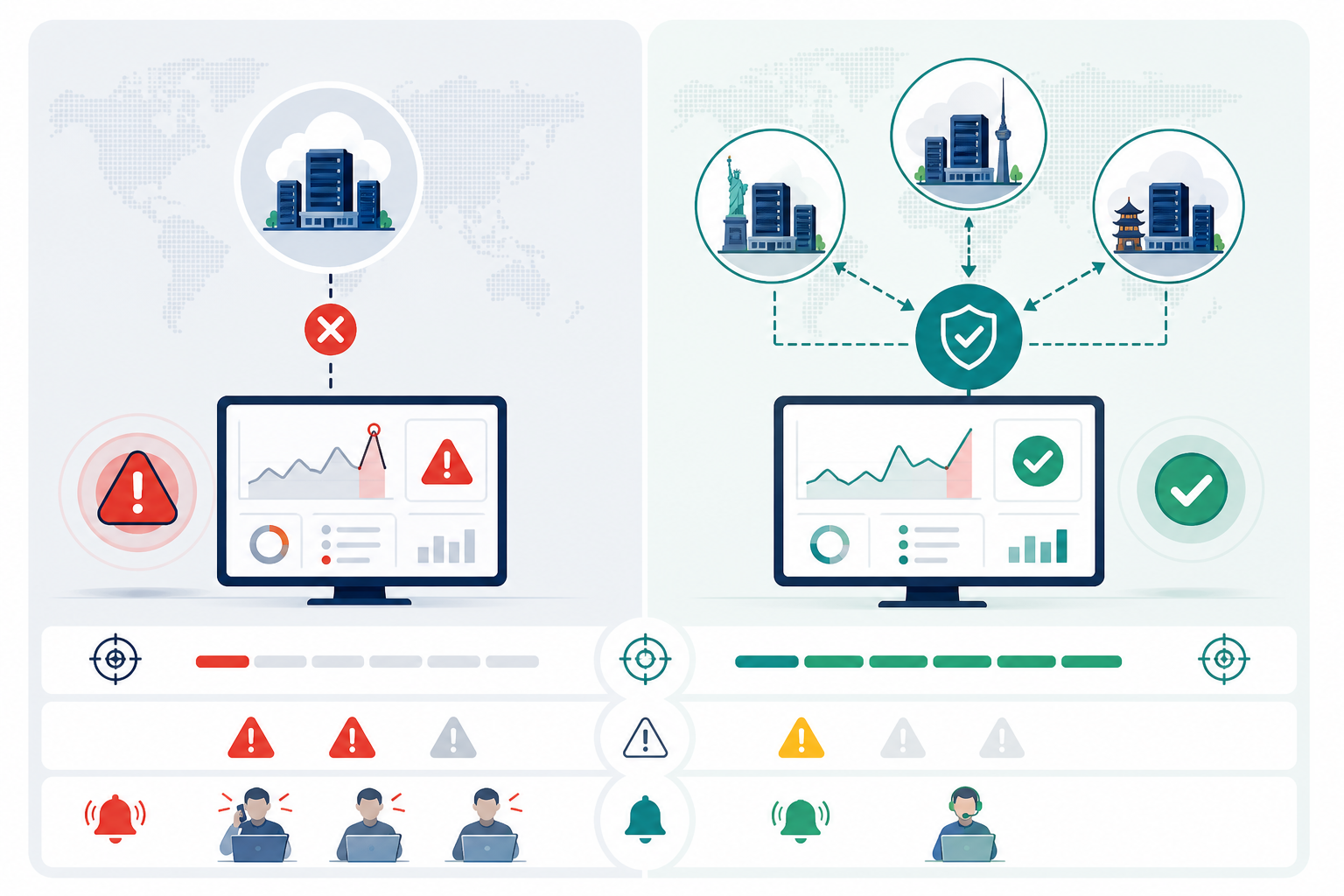
If you're running a personal project where the occasional false alert is a mild annoyance, single-region checks might genuinely be fine, and there's no need to over-engineer it. But if you're monitoring anything customers, revenue, or an SLA depend on, that gap in uptime monitoring accuracy stops being a minor inconvenience and starts being a real business risk, even for a small team.
How multi-region monitoring reduces alert fatigue for on-call teams
Here's something I think gets underappreciated: alert fatigue is really a trust problem dressed up as an annoyance problem. And trust, once damaged, is hard to rebuild.
Think about how this plays out on a real team. An engineer gets paged at 2am for a "site down" alert. They drag themselves out of bed, check the dashboard, and everything's fine. It happens again three nights later. And again the following week. By the fourth or fifth false alarm, something shifts psychologically. That engineer starts glancing at the alert, thinking "probably nothing," and rolling back over. That's genuinely risky, because eventually one of those alerts is going to be real, and the response is going to be slower because trust has quietly eroded.
Multi-region verification helps, but it's not the only lever worth pulling. A few practical steps make a real difference alongside it:
- Set severity levels so a single-region anomaly and a fully verified outage don't look the same in your alerting channel. Not every event deserves a page.
- Deduplicate alerts so a flapping check doesn't fire five separate notifications for what's really one ongoing issue.
- Use maintenance windows for planned deployments or known infrastructure changes, so expected downtime doesn't masquerade as an incident.
- Build an escalation policy that only wakes the next person up if the first responder doesn't acknowledge within a set window, rather than paging the whole team at once.
- Track your false-positive rate over time. If you don't measure it, you won't notice it creeping up, and you won't know whether your verification policy is actually working.
This is also where your alerting channels matter. Whether you're routing incidents through Slack, Discord, Telegram, or a custom webhook into your own systems, the value of that channel depends entirely on the signal-to-noise ratio flowing through it. A Slack channel that pings every five minutes with false alarms gets muted. A Slack channel that pings rarely, and accurately, gets watched closely.
There's a downstream benefit too: a clean incident history. When your monitoring platform isn't logging phantom outages, your postmortems are actually meaningful, and your public status page reflects reality instead of a string of confusing blips that make your service look flakier than it is. Customers checking your status page during a real incident deserve accurate information, not a history cluttered with false positives from three weeks ago.
How to choose a monitoring tool with regional checks
If you're evaluating monitoring tools, whether you're switching providers or setting up monitoring for the first time, it helps to ask different questions depending on the type of check, since verification doesn't work the same way for everything.
Probe-based checks: HTTP, HTTPS, ping, port and API monitoring
- How many regions does the tool check from, and where are they located relative to your actual user base? A tool with checkpoints clustered in one part of the world won't give you much diversity for verification, and it won't tell you much about users on the other side of it.
- What's the verification logic before an alert fires? Is it majority vote, all-region agreement, or a configurable threshold you can tune? Ask about retry counts and the confirmation window too. Vague answers here are a red flag.
- Does it offer response-time analytics that show regional performance differences, not just a binary up/down status? Seeing that your API responds in 80ms from London but 400ms from Singapore tells you something useful about real user experience, not just availability.
Schedule-based checks: SSL certificates and domain expiry
These don't need multi-region confirmation in the same way, since they're checking a certificate or registration date rather than live network reachability. What matters more here is how far in advance the tool warns you and how reliably it re-checks.
Event-based checks: cron, heartbeat and DNS monitoring
Heartbeat monitoring relies on your own system checking in, so verification looks more like a grace period before flagging a missed check-in than a cross-region vote. DNS change detection depends on which resolvers and authoritative sources the tool queries, so ask specifically how that works rather than assuming it mirrors HTTP verification.
Can you export incident data via API? This matters for avoiding vendor lock-in. You want the freedom to pull your own data, run your own analysis, or migrate providers without losing your historical record.
We built Moonitor around this kind of thinking, applying multi-region verification where it genuinely fits (HTTP/S, ping, port, and API checks), rather than pretending every monitor type works identically. It covers eight monitor types in total, and setup takes under a minute if you want to see how the verification logic behaves on your own infrastructure. There's a seven-day trial with no credit card required.
Frequently asked questions about uptime monitoring accuracy
Why do I get downtime alerts when my site is actually up?
This often happens with single-region monitoring tools. If the monitor's one checkpoint hits a temporary network issue, ISP routing problem, or brief DNS hiccup on its end, it can read that as your site being down, even though visitors elsewhere load it normally. It can also happen with a badly configured check, such as a keyword test looking for text that no longer exists on the page.
Multi-region verification solves the location-specific version of this problem by confirming failures from a second or third checkpoint before anything gets flagged as real downtime, but it won't fix a broken test definition.
How many regions should a monitoring tool check from?
There's no magic number, but two to three geographically distinct regions is usually enough to distinguish a real outage from a local network blip, provided the quorum policy is sensible, for example requiring two out of three regions to agree. What matters more than the raw count is whether those regions reflect where your actual users are and whether the tool uses them to verify failures before alerting, rather than simply listing multiple locations as a feature.
Does multi-region monitoring slow down alert speed?
There's a small delay, typically a matter of seconds, since the system needs at least one other region to confirm the failure before declaring an incident. Stricter policies, such as requiring every region to agree, add slightly more delay than a majority-vote policy but reduce false positives further.
In practice, this trade-off is worth it for anything customer-facing: a few extra seconds to confirm a real outage beats getting paged immediately for something that resolves itself before you've opened your laptop.
Can false alarms damage trust in monitoring tools?
Yes, and it's a bigger deal than most teams realise early on. Once engineers get burned by a few false pages, they start second-guessing every alert, checking manually before responding, or muting notifications altogether. That's how a real incident ends up getting missed.
Reliable, low-noise alerting isn't a nice-to-have. It's what keeps your team actually trusting and acting on the system when it matters.
Final thoughts on improving uptime monitoring accuracy
At the end of the day, uptime monitoring accuracy isn't about checking more often or from more places for its own sake. It's about building a verification policy that reflects how your users actually reach you, and being honest about what it can and can't catch.
Three things are worth taking away:
- Pick checkpoint regions that match your real user base rather than defaulting to whatever's easiest.
- Define a clear quorum and retry policy instead of leaving it vague.
- Review regional response-time data separately from simple up/down status so you catch slow degradation before it becomes an outage.
Get those three right, and your alerts start meaning something again, which is really the whole point of monitoring in the first place. 🌙